March 21, 2010
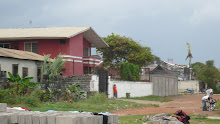
Robertsport, Liberia/ Monrovia, Liberia
We did our final pilot training session on Friday at the Robertsport vocational training center--the YEP (Youth Education Pack) center under NRC. While half of our group had taken the trainees to the local market to do a market assessment, I stayed behind to do some informal interviews with staff and students at the center. The tailoring class was packed, though I later gathered that not all the students in the room were tailoring students. I think some were just hanging out there to avoid the sun. The teacher was a thin weather-beaten man somewhere between 35 and 45 years old. Over his thin upper body hung a tie-dyed collared shirt. He told me the tie-dye class had made the fabric and he stitched the shirt for himself. He proudly showed off the clothing his students were working on, mostly dresses and pants for toddlers. When I admired the sewing machines, he lamented the fact that he only had 5 working machines for the 20 students in the class. The sewing machines were foot-pedal-powered. While most of the students were girls, he has two boys in his class.
The masonry students were cocky and boldly called two of us over to talk to them. They were hard at work building “a square”, as one laughingly told me. They construct house frames and other practice tasks each day and knock them down after so they can practice another one the next day. One flirtatious 16-year–old told me his father lives in Philadelphia. When I asked him why he’d chosen masonry as a vocation, he said it was easy to find a job, though not in Cape Mount (their county) so he’d have to leave the county to find work.
Over at the pastry class, a group of girls huddled around large mixing bowls making shortbread. They showed me the dye they use to color the cake yellow and everyone laughed when the bottle leaked and dyed my fingers bright yellow. When I again posed the question “why did you choose this vocation?” one girl told me it was “fast money” because they could bake bread or cakes and sell them that day. Another girl giggled and just said “I love pastry!”
The hairdressers had come back from their day at agriculture class. Each vocation takes agriculture class once a week and after class they have free time to hang out at the center. There is a large field next to the center where the youth learn to grow three types of cassava along with other vegetables. This is considered a core skill that they all learn along with literacy, numeracy and accounting. This center also offers classes in human rights and peace education, but we weren’t able to see any of those classes in action.
A little girl sitting with her mother, who is herself a young cosmetology student, stared at me for a moment and then asked, “Is that your real hair?” Pointing to the long braid down my back I told her yes, and looked up at the braids hanging posted on the wall, weaves to use in their classes. All the children of mothers in the vocational training programs had intricate hairstyles thanks to the plethora of aspiring hairdressers training there and looking for willing practice subjects.
The carpenters… well, they were a trip. I walked over the group of young men off to the side, working around a few sawhorses and piles of wood, hoping to snap a picture of the carpentry class for use in our video. The minute the guys saw me and my camera they started posing and demanded I photograph each of them with the table, or stool, or bench they’d made. They then proceeded to pose for me “in action”, sawing wood or hammering a nail. I now have about 30 photos of shirtless teenagers posing goofily with their tools. Boys are boys everywhere.
The day rounded out with a “cultural performance” including singing by some of the more outgoing and charismatic students, if not the most in-tune. Finally two boys stood up and sang/rapped a song about the NRC (“N-R-C, we pray for you, N-R-C, we pray for you….”) and ended it with the little 14-year-old dancing with Nora, which as usual made everyone’s day.
Gettin' Down in Vayetown
March 18, 2010
Monrovia, Liberia
The project is going well. Which is surprising me because our plans had seemed so spur-of-the-moment when we left New York despite months of planning. I’d had so many questions and doubts, most of which centered on whether we were capable of adding any value to the programs here in Liberia. What do we know about vocational training? About vocational training in Africa? In Liberia? What did we know about market assessments and even about training people here? The video was a rinky-dink production using borrowed cameras, poor lighting, no external mics, our team-members as actors, scripts written by us, and editing in a single 10-hour day by me and Nora. I was tempted to tell the rest of the group that we hadn’t been able to produce the video after all to avoid the embarrassment of showing it here.
But shockingly enough the training and the video and our written short guide have been a wildly popular activity here. And participants told us our hands-on activities were “fun”, “useful” and that they’d use them again in the future with the youth. Again, I’m still quite skeptical but the thing I’ve realized is how dedicated the staff are to the vocational training programs. And how committed the students are to learning vocations and to succeeding. And this means they want to learn. We’re welcomed more warmly that we could ever expect and every listens attentively, and waits patiently for us to finish a section to tell us that we’ve spoken waaaay too fast and they haven’t understood a word!
I’m inspired by the youth. Today, Charles, who is around 14 or 15 years old, remembered all of the steps of an interview in our role-play activity. He introduced himself to the staff member pretending to be a “Restaurant Manager” and took care to thank him at the end, shaking his hand. He's so motivated to succeed and listened to ever word today, synthesizing the information perfectly in the focus group later. Charles has a large scar, close to five inches on his neck and I can’t help but wonder about his past. What was his life like during the war? Is the scar and accident… or a wound inflicted by another human? What does Charles dream about at night?
On the drives each day to vocational training centers, we pass by over and over ruins of houses, with no roofs and half-walls. Many of them have families squatting in them or they’ve been converted into a corner store. We drive by billboards with text: “Grow the food you eat. Eat the food you grow” “Stop Rape” (with drawings of a man on top of a protesting woman and a large X through it) or “Use treated malaria nets.” The country knows what messages it needs to send to its citizens.
Today was a special day for me—I’ve made my mark in Liberia. Vayetown is a small remote village about 45 minutes drive on a pothole-riddled dirt road from Tubmanburg. The vocational training center there has mostly older students and I’ve leaped to the conclusion that this town was heavily hit in the war. This would account for why so many young adults have not attended school. (Only those not in the school system are eligible for the VT programs. This is an attempt to address the problem of the thousands of young people who missed years of schooling while living in refugee camps during the war.) Don’t worry, this isn’t the special part. That’s coming. We had a great training session, despite unexpected setbacks—the generator went out and we had to suspend our video showing and jump to a different section of the training until a new generator could be found. It’d also taken us an hour longer to arrive than we’d anticipated due to the poor condition of the roads. But the staff and students were receptive and I feel I can safely say we’ve left them with motivation to do a market assessment for their area and improve on their programs. At the end of our training, the director told us the students wanted to welcome us in their special way by performing traditional African dance. We certainly didn’t mind and while the 140 students from the entire center piled into their large classroom, drummers set up and the dancing began. First a group of four young women around 14 years old and later three young men of the same age. After the dance (which was amazing of course) we thank everyone, exchanged contacts information and took some photos. As we started to enter the car I couldn’t help but shake by booty a little bit and do a 2 second version of their dance and a few of the girls noticed and started laughing. Nora quickly joined in, and within seconds we had a large crowd and drummers materialized. We did our thang for a few minutes and judging by the faces of our onlookers in the photos, we’ve provided some laughable memories for the students for at least the next few months. My conclusion: My lack of shame was clearly a winning quality today.
Only stray dogs pepe here
March 13, 2010, Monrovia, Liberia
What am I doing here?
As part of my capstone project for my Master’s Degree (International Affairs) along with a group of other students, I’m working for the Women’s Refugee Commission who in turn partners with the Norwegian Refugee Council (NRC) in Liberia. We’re working to make the “Market Assessment Toolkit for Vocational Training Providers and Youth” more user friendly. The Toolkit is a 130+ page manual for how to link VT programs with market assessment, thereby ensuring that the youth trained in various vocations actually exit the program are able to actually use the skills learned. For example, if a VT program trains all their youth to be carpenters and tailors and floods the market, not all those young people will earn a living in this way. But a market assessment might highlight the need for mechanics and opening up a new training program in mechanics could ensure that young people can get jobs. Our task is to make this Toolkit easier to use, through a training we’re developing that can be replicated by VT program staff, a shortened version of the Toolkit and instructional videos. We’ll be visiting four VT programs coordinated by the NRC in our time here and piloting our preliminary training tools, including some very embarrassing videos we’ve filmed and edited back in New York. That’s pretty much the deal. And if that seems confusing, it is. We’re still wrapping our head around the project. We’re also only in “the field” (i.e. Liberia) for two weeks, so we’d better use our time wisely.
Initial thoughts:
The streets are lined with people pretty much everywhere. Markets look like the pictures I’ve been downloading online for our videos. Next to the government ministries, people are hanging around, selling gum and fruit. I’m so used to traveling and working in other countries where most people don’t speak English or if they do, it’s only to me, not to each other, so sometimes I forget that the language they’re speaking is English. It’s also sometimes hard to understand because, as McNeil told us, “We drop letters. We speak quickly and don’t say the whole words.” McNeil is from Monrovia and has a permanent smile. He works for the NRC. I’m not sure if that’s how you spell “McNeil” or if that’s even his name because, as he told us, Liberians speak very fast and slur the words together. For now, he’ll be “McNeil” in my blog. When I asked McNeil if people danced a lot in Liberia (basically trying to get us an invitation to go dancing somewhere) he said “What?! What?! Hahahahaa”. He then launched into a monologue about how you can’t ask questions to Liberians, because they’ll only answer with a question. McNeil giggled for the next half hour we joined in. It’s impossible not to smile when around McNeil.
Outside of the NRC compound, there are words painted on a wall. Nora looked at it and said, “What does that say? ‘Only stray dogs…’ Oh!” Someone had written in blue paint, “Only stray dogs pepe here.” We all laughed, along with Fred, our NRC supervisor. Fred is from Uganda but has been living and working in Liberia for the past 4 years. Nora’d seen it written on a few different walls. I guess it’s a reminder for people not to pee on the wall? I’m thinking of adopting it as a new phrase that can mean anything from “That bar? I’m not going. Only stray dogs pepe there” to “My house is a mess. Only stray dogs pepe there.” An all-purpose phrase that can be adapted to any occasion.
The NRC compound seems lavish in comparison to the houses nearby. There is a pool in the middle and air conditioned buildings. But paint is cracking in a way that reminds one of the remains of luxury in Cuba… or the UNRWA buildings in Palestine. The NRC is settled amidst a herd of UN and NGO headquarters. The road there is an adventure in alphabet soup: UNICEF, UNFPA, IRC, NRC…
Our apartment building, which houses only expats, most of whom work at the NRC, contains large apartments with air conditioning and keeps us sealed off from the malaria-carrying mosquitoes. We even have a TV, and off-again-on-again wireless internet. The tall wall around our apartment building has barbed wire and sharp glass at it’s top, preventing intruders and there is a 24-hour guard. Across the street, people mill during the day and after dark outside a broken-down building, reminiscent of Detroit, selling water we’ve been warned against drinking and candy. There is a building curfew of midnight on weekdays and 2am on Saturdays. We’ve been told never to walk around after dark. From the 2nd floor of our building we can see the ocean but have also been warned against the beaches, both because of “crazy people” and an intense undertow which can pull you down even if you only wade up to your knees.
Lebanese people seem to run this town—at least as far as major businesses go. I opened up google on my computer and was confused then it came up in Arabic, wondering if it was detecting some setting from when I’d been working on my Arabic homework a week before, even though this didn’t really make sense. I clicked on the button to switch it to google English and saw that I’d been directed to www.google.com.lb, “Google Lebanon”. Fred told us that Lebanese families are the privileged class in Liberia and they own a lot of property in Monrovia, many apartment buildings, restaurants and hotels. We passed by Leela Café and Salaam Store. Most of the "white people" I’ve seen looked like they’re probably Lebanese—An interesting dynamic. I wonder if I’ll end up practicing my Arabic while in Liberia, quite unexpectedly.
On our ride from the airport to Monrovia last night with Sharif, who also works for the NRC, the radio announced that Charles Taylor’s wife had given birth to a baby girl that day. The commentator asked the informant, “So Charles Taylor has time to see his wife?” “Oh yes, he has all the freedoms of a regular person.” The commentator went on to ask more questions insinuating conjugal visits at which point all of us in the car started laughing, Sharif laughing the loudest. The informant assured the commentator that he would share with the Liberian people the name and birth weight of the child as soon as he found out more details. For some reason the commentator was intent on extracting this particular information. Sharif told us many people are happy that Taylor is in the Hague, but many others are not, because they enjoyed kickbacks during his regime and now, without these privileges they have a harder life and must find work. Others believe Taylor should be tried in court but are not happy he’s been taken to Europe for the trial.
It’s interesting to finally experience the type of market we’ve been talking about “observing” as part of the Toolkit. We marveled at the live giant snails being sold and the fish, dried and with their mouths locked in a bite onto their tails and sold in rings. We bought a mélange of fruits and vegetables to make a pasta sauce and will be trying some white half-tomato-half-potato-like vegetable tomorrow. One of my favorite things to do when away from home is try new foods, though I'll admit its led me to some "mistakes" at times (I'm referring to the cockroach I ate in Thailand). I’d brought along the video camera to shoot some footage for our market observation video and little kids and teenage boys came flocking to me, all willing to be in the video. Older women held their hands in front of their face, saying, no, not me. I felt like a tourist and wanted to call out “No, it’s for an actual project, I’m not just a tourist.”
My first thoughts: Liberia is hot, and very green and people wear colorful clothing with great style. Oh and you can buy Chucky, Bride of Chucky, Scary Movie and Scary Movie II all on one DVD for $5. And people seem nice so far. When I’ve been outside our apartment for more that 3 hours I’ll have more to report.
July 11, 2009: "How will your project help me?"
Last week I headed back to a community center in East Amman that works with a combination of Palestinian-Jordanians and Iraqi, Somali, and Sudanese refugees. They center mostly holds classes for youth and adults in English, Arabic, computers, art, sports, etc. It's mostly for youth who don't go to school for whatever reason. Some of them are refugees and have been out of school for quite some time (until 2007, Jordan did not provide free education to non-Jordanian-citizen children); some of them don't got to regular school because they need to help work to support their family. Some of them have simply dropped out. Adult come to improve literacy and computer skills. M, the director, had told me earlier that from the beginning he laid down the law that "Here, we are one people, not Palestinian or Iraqi or Somali, just people." He told them "I don't want to have to fire anyone. Or kick anyone out." From then on he claimed they hadn't had any problems, but he said that many of the other centers in other areas had a lot of problems between groups of students or teachers.
M had kindly set up a focus group with some of the Iraqi teachers and one Palestinian-Jordanian teacher. From the beginning they were friendly, but guarded. The Palestinian teacher, Menal, asked me at the beginning, "What is the point of this project? What will it do to help me? How can it improve things?" I was at a bit of a loss. Probably nothing, I thought. I told her, I wasn't sure, but hopefully someone would read our report and at least understand better the challenges facing her community. And perhaps an NGO would provide more helpful assistance. That was all I could offer. Menal went on to stress the vast divide between the Palestinian and Jordanian community and the great amount of discrimination she felt. She wasn't very hopeful for the future and couldn't envision anything that would make it better.
When it came to the plight of the Iraqis I felt even less useful. Was I just pouring salt on wounds by asking these questions? I hoped it was helpful to give them a forum to vent. They can't get jobs, even with their master's degrees. The one young male teacher told of playing guitar at a coffee shop and being kicked out by the police, because he is Iraqi, literally thrown out the door, in front of his friends. The older female teachers told of how their husbands couldn't get work, and sat around becoming more and more depressed each day. How their children were harassed in schools. How they just didn't feel at home, even after six years. They were just waiting for resettlement in America. And what could I do for them? Could they take my contact information? Of course I gave that but hoped they didn't assume that would help them gain resettlement. One woman looked as if where going to cry. What can one say? No, my research won't solve their problems. Any of them. All I can do is sit there and listen.
July 27, 2009: Six things I've learned.
1. Do not attempt to flush toilet paper down Jordanian toilets. Especially not in your apartment where it could hypothetically stop up the drainage pipes and cause "poo water" to flood your bathroom.
2. If you don't drink coffee and tea, don't come to Jordan.
3. If any man asks you if you are married the answer is always "YES"!
4. Post offices are mythical creatures is Amman.
5. If you invite your friendly landlord in, you might end up editing his wife's "toastmakers" speech on saving water for the next hour. This is ill advised thought likely not optional.
6. Do not expect anyone to give you the correct directions. It makes no difference if they speak English. You will still need to ask five more people before you reach your destination. If they speak very little English they will likely tell you "direct". This does not, in practice, mean "go straight". It means "Nice to meet you, now go away."
Do not be fooled by their eerily convincing directions either. "Go straight for 32 kilometers. Then right and go 13 kilometers. Then you go left and 3 kilometers." This means the same thing as "direct".
June 27, 2009: Wadi Mujib, Michael Jackson tribute remix, and “batih!”
Wadi Mujib: one of the coolest hikes ever. Unfortunately also one that is not really meant for people like me--that is, those of us who believe we are a bit more dare-devilish than we actually are and who have both a lot of pride and a lot of fear. I was told before embarking on this trip "If you're scared of things, this is not for you." Um...
After taking a 4 hour detour on our hour and a half drive to Wadi Mujib Nature Reserve (the detour involved us in some olive orchards in the countryside, getting a flat on the Mujib Dam and drinking tea with the policemen who helped fix it in exchange for a rendition of Billie Jean—well I’m not entirely sure they wanted us to sing it--, eating at some cute but disgusting restaurant with maggot-things in the orange juice, and all the while unable to find a radio station that played any Michael Jackson, therefore forcing us to sing every MJ song we could think of, loudly and off-key with incorrect lyrics) we arrived to the site, which looked like simply a road-side stop-off. Little did we know, as we were advising our friend Tanya not to bring along her purse as it “might get wet.”
There we were geared out in bathing suits (but covered in shorts and t-shirts) and all wearing the shoes with the most traction we could come up with. We’d heard this hike wasn’t as difficult as the others but seemed scary to some and would probably involve getting quite wet. I was ready—it was close to 100 degrees out and I’d applied about 4 layers of sunscreen by that time.
The first ten minutes we laughed as we lowered ourselves down a ladder into a river bed and started off through the river, wading in ankle-deep water into a crevasse between two mountains carved out by the river. It was beautiful and shady and birds soared overhead. We though “this is beautiful, but hey, next time let’s do the hard hike.” In a voice to make Emma Thompson proud, “Little did we know…” It started with some small rapids and we thought “ok, ok, the hike is kinda cool.” But then we came to the first ropes. I’m not entirely sure how to explain in words and we clearly didn’t have a camera with us, but you swim (and I do mean swim, because you can’t touch ground anymore) over to some ropes strung along the rocks on the side and pull yourself through the strong current up to a giant slippery rock that you then hoist yourself up onto and over. For a moment there as the current was pulling me backward and I saw the rock in front of me I seriously thought “this might be it”. It seems a bit silly in retrospect but it was hard to imagine how I’d get back without being swept into the current and dashed on the rocks downstream and I was sure there was no way I’d have the strength to get myself to the rock, let alone up it. Fortunately we'd brought with us our friend/housemade Bill who served in the reserves in Iraq for a year. I've never been so happy to have an "army guy" in my midst. Seriously he was pretty bad-ass and certainly either saved my life a few times or at least facilitated me continuing along the trail so that he would have more opportunities to save my life at the next rope climb.
We pass some travelers on their way down who tell us the next one is "the toughest part". Oy, I thought. But now I couldn't go back. How would I make it down that waterfall I'd just gone up? Plus we had Tanya with us who was in jeans (heavy when wet) and shoes with less grip. If she could make it, I certainly wasn't going to back down. (There goes the pride for you.) Plus I passed a few women in hijab which I'm sure was also weighing them down. I thought that if I was going to be a scantily clad as I was (t-shirt and shorts) I owed it to the country to make it to the top.
The next part was yet another rope pull and then a rock with a flat vertical face you had to plant your feet on and just pull. Getting to the top of that slippery rock and I was told to "just jump" the next one. Seeing my dubious demeanor, a guy who seemed sure of his footing offered and hand and pulled me across. I just had to grab the hand and jump across, leaving it up to Allah. Fortunately Allah was with me. Tanya didn't have quite that degree of trust (probably the more practical standpoint) and Army Guy had to plant himself against the current, wedging his feet in between rocks and basically pull her through the current.
Keeping the rest of the hike to a minimum because the rest of the way up was dotted with these types of challenges about every ten minutes, we got to near the top when there was a place where Israr, being the lanky gumby-man that he was could spread his legs wide and avoid the brunt of a waterfall and literally climb up the waterfall. Noam unfortunately found this a bit more difficult and I saw him get the full water fall in his face a few times before, with Israr's help he was able to make it up. Seeing this I declared I was more than happy to wait with Tanya on a big rock for them to go the rest of the 15 minutes up and come back for us on the way down. But Army Guy was having none of it and ended up pushing my foot up and I reached up for Israr's hand and the two of them basically are the only reason I actually made it to to the top. Shukran, habibis.
The way back was amazing however. At least for me who loves jumping off of rock and sliding down waterslides. It felt like a natural waterpark. Again a bit of trusting in fate, but the way down made the trip worth it. Israr got to take over from Army Guy, playing the hero role. He splayed out in true gumby steez to save a young Filipino exhange student, eventually creating a bridge out of his body and rolling her over it. Perhaps words to not describe this feat.
Our group was split in half between those planning to come back and do the "hard" hike and those of us who were pretty damn stoked and proud of ourselves but fairly certain we wouldn't be seeing this place again. Masalaama Wadi Mujib.
The way back we stopped for some roadside arguileh with some old men in kuffiyehs, selling sodas and playing the rababa alongside the Dead Sea (Bahara Mayyeh). Bill made friends easily by continually answering all their questions with "batih!" ("watermelon"). They found this funny for about fifteen minutes and then began looking at each other and making the sign for "crazy". After posing for a photo with some random guys who wanted a photo with me and Tanya (we assume we're now "sahibati" for them, "look at my American girlfriend!") and concluding that the rababa player was unlikely to know "Beat It", but sharing a moment of silence with them about Michael's passing, we bid our goodbyes.
I thought it beautiful that Jordan contains adventures greater than that of braving the Amman city roundabouts and slept well that night.
June 18, 2009: Far Away
Feeling so very far away from my family today. In coping with loss and some of us across oceans and in different time zones, how does one support? get support? Thank goodness for skype. But it's not really a substitute for getting or receiving a hug.
June 15, 2009: What will they find in America?
Today was a new day. A busy frantic getting-lost getting-lost again talking asking listening learning seeing going feeling day.
We conducted three interviews, one with a high up politician man in the major Islamic opposition party (IAF), one with representatives from Al Jazeera Amman and one with an English class of Iraqi refugees living in East Amman. Basically West Amman is wealthy and has lots of foreigners and cute cafes and East Amman gets less services, less water, it's where the Palestinian refugee camps are and where many Iraqis live--those who don't have the money that most Jordanians perceive Iraqis to have.
All were interesting interviews, but I was most affected by our trip to East Amman where we'd been told not to go after dark. The streets are narrow and we saw trash on them for the first time in Amman. We drove by one of the refugee areas and there are children in tattered clothing running the streets at sundown, something you NEVER see in West Amman. Everyone in West Amman seems to be wearing the newest Gap and Zara and Adidas. (Clearly i'm exaggerating but it's my impression). We weren't sure what to expect as we drove off into the netherland of East Amman this afternoon at 6, already exhausted from a full day.
After getting lost five or six times (now the standard), we finally were able to meet up with Rami*, an Iraqi who is being resettled in Tennessee in a month, thanks to his help as a “mutarjim”, a translator, for the American army. He hopped in the backseat and instructed us on how to get to Kumiko’s apartment where the English class was being held. I wasn’t sure how on earth they’d expected us to find this place, given the sparse directions we’d been given, but I’ve given up being surprised by the directions in Amman. People seem to assume you’ll just ask around 6-7 times until you find some landmark someone can meet you at. This is the third time we’ve had to resort to this method. I have to say that probably a tenth of our time here in Amman has been spent lost in our Toyota Camry. Poor Israr had to keep rolling down his window to ask "Where is Hashemi?" or "Where is Plaza Mall?" and decipher the cryptic answers for me as I skirted death by crazy driver and dodged people leisurely crossing major roads mid-traffic.
And who is this Kumiko? We weren't sure. We’d met a Syrian-American guy the week before, doing medical research on refugees, who’d put us in touch with Kumiko. She turned out to be a Japanese woman who’s been living in Jordan for 14 years, speaks Arabic as well as English and hosts English classes in her apartment every night for refugees. She’d invited us to come by tonight and we’d said yes of course, hoping to get some information on the Iraqi experience in Jordan, but knowing we might not have any formal interviews.
We were right about that. But had a much more rewarding experience. And saw a window into the lives of Iraqi refugees in Jordan. Rami led us in and introduced us to the class. I dazzled them with my meager Arabic skills “Ismee Heidi. Ana min Amerka. Sakne fee New York. Ana taliba fee jama’a Columbia, buss sanke fee saef fee Amman.” From that moment I was a celebrity. We then switched over to English as that is after all why they were there. Abdul explained that he was being resettled in Illinois, where his daughters already lived. He’d been rejected once before for resettlement, because of his service in the Iraqi army, even though he’d done work for the Americans, but finally had gotten his papers and now was leaving in five days. Hussein was leaving for North Carolina in 8 days, and Ali for Ohio in a month. Samer and his daughter Aliya were still waiting for resettlement. Rami told us how he’d been angry for a while at how long it took to get his resettlement, even though he’d work for years for the American army, but he said with a grin, “Now I’m leaving in a month for Tennessee, so I’m not angry anymore.”
Rami was the teacher for the day, having excellent English skills. During the middle of the class, as students were struggling to pronounce “p” versus “b” (Arabic doesn’t have a “p” sound), I tentatively raised my hand, remembering a trick from my teaching-English days, and offered to help. I was invited up to show them how holding a piece of paper in front of one’s mouth when speaking could demonstrate that when you say “book”, the paper doesn’t move, but when you say “park”, the paper moves with the air from the aspirated P. For the next 20 minutes, I was invited to continue teaching the class, as a guest teacher. We went through “C” words, “D” words (dinosaur was the first suggestion, from eight year old Aliya tagging along with her dad to class), and “E” words. Somehow “era” came up which fortunately an Iraqi woman with excellent English who was helping out the class was able to translate. It was both deeply rewarding to spend time doing hands-on work again, and also heartening to see the work of not only Kumiko, opening her home and giving energy to the places where help was truly needed, but also the comraderie between students, with those who knew English volunteering to teach the class every day. They offer two levels of English as well as men’s and women’s classes. And two hours each day. It’s really a great group.
But it was also very depressing for me to think of the lives ahead of these Iraqis, most from Bagdad, but one from Basra and one from a smaller town I’d not heard of, all educated with lives from the past that were no longer possible. I thought of those headed to Ohio, Tennessee, North Carolina. What will they find there? Each are struggling with English and I know Americans aren’t particularly patient when it comes to people who can’t speak English. And I know they’ll face racism and anti-Arab—particularly anti-Iraqi sentiment at times. I’m worried for when Aliya is resettled. Where will she end up? Will her classmates make fun of her accent? Will they call her “the enemy”? I told them that they were going to nice places. And I asked them if they had any questions about America, but they just looked at me with anticipation for what was coming and smiled at me and thanked me for visiting. I do believe my country has many wonderful aspects. And the children of these men will probably live a good life, and will hopefully be fortunate enough to travel to visit their parents’ homeland some day, but it made me incredibly ashamed to represent this “great country” that had bombed their towns, killed their friends and family, and which was now hesitantly opening it’s doors to them only to throw them racial slurs and hard work when they arrive. I know the situation is more nuanced, but the facts remain...
Maybe it’s the air tonight, but I’m feeling a bit disappointed in the world. Right before I left, Kumiko said “You study human rights? I need so much help. So many problems. Please come help.”
*all names in the above blog entry have been changed, because I didn’t ask permission to use names in any writing.
A note on women’s equality.
This blog entry makes me feel so very much like the stereotype of the Western woman who finds fault in womens' place in the Arab + Muslim world. And I feeling wierd about that. But I also promised myself I would write down my experiences and feelings truthfully, so in that spirit...
It’s hard to be a woman here I’ve decided. Or harder than I'd anticipated. I have no problem dressing more modestly than I would in the United States. I actually come to appreciate it. And it’s funny. I feel almost naked now if wear a skirt that just barely covers my knees or a tank top. It feels like the equivalent of walking around Brooklyn in a tube top and daisy dukes. I’m certainly granted a great degree of freedom as a Western woman, an obvious foreigner, yet with this I feel deep responsibility. I feel that I should be careful not to perpetuate both the stereotype of Western women and the sense that it’s my right to buck the system here, which I do not believe it is. And after all it's just clothes.
However, it is certainly not the case that women have equal rights to men in this society, despite some who have told me otherwise. Towns we’ve driven through, smaller areas, far from Amman, were void of women outside the homes. I managed to go an entire day of driving through towns without seeing a single woman. It was hot out and I know I’d been less likely to go outside clad in a long black dress too, but as much as I want to be culturally sensitive to clothing rules, I can’t help but feel it’s unnecessarily hindering if the clothing means you’re trapped inside. And today, in an interview with a man from the Islamic opposition party, he told how it was a problem that international NGOs were coming in and trying to say that men and women were equal. That's a bit hard to swallow. A group of women had told me something similar earlier but in much different terms. They said “The Western people see us in hijab and think we are oppressed, but we’re not—we’re completely empowered—we have jobs, we have good pay, we make our own choices. Those people are just imposing their view of women’s empowerment onto us and not looking at our own kind, own own form of empowerment.” I whole-heartedly had to agree with them. But their words seemed quite different to me than the man’s words of today--having a fundamental problem with the idea that men and women are equal. I’m trying to process this and perhaps sleep will help me understand. I want to be open-minded but am feeling exhausted from the day and am not feeling so open.
Link to an interesting gender study of the small town of Sahab, produced by JOHUD (the Jordanian Hashemite Fund for Human Development): http://www.johud.org.jo/Latest/why-don-t-women-join-the-work-force.html
June 14, 2009: "Petra & Wadi Rum" or "Camels have black hearts"
June 14, 2009, Sunday
Petra
This past weekend was filled with a visit to the sites that Jordan is famous for—Petra and Wadi Rum. Despite the worries I always have upon finally visiting the famous sites of the world—which are rarely justified—, Petra was quite spectacular. Beyond the beauty of the location, massive red rocks in a sea of red desert, and the fact that these pillars, facades, rooms, were carved into the rock itself, with no modern tools is breathtaking. We were lucky to have arrived early, by 8am to avoid the later tourist sh$t-fest we witnessed on the way out around 2pm. We’d originally intended to reach the hostel the night before at 11, go to sleep right away and get up at 6, but an “navigational detour,” taking us along the King’s Way, a beautiful yet less direct route, provided us with no beauty as it was nighttime, a few scares on the windy mountainous road, and hostel arrival of 1am. However, the point was that we made it. Part of the excitement of Petra lies in the winding entrance-way, along the road made through giant rocks by an earlier river. As you make your way though this crevasse, at each turn you wonder if you’ll behold the treasury but each turn reveals more road and perhaps a few small human-carved caves with inscriptions. And when the path finally opens up to the Treasury, you feel you’ve earned the incredible site. Bad at estimating heights and distances, all I know is that it was massive. Perhaps the photos on the side bar can give you an idea. The rest of the area of Petra is filled with more cave homes, carvings roads, and finally, about a 45 minute hike above, you reach the Monastery, a building equally impressive to the Treasury. And above the Monastery there read signs “All places from here” and “View of End of World this way”. While I laughed when I read this sign, I had to admit that from the viewpoint, it did appear to be the end of the world.
It’s hard to say much more about Petra, other than that I certainly merits its place up with Machu Picchu on “Things to see before I die” lists. One guide we met while exploring told a tale of a 79 year old man who had always dreamed of visiting Petra, and then upon seeing the Treasury (famous from the photos) had a heart attack and died. This was alone in cute Petra-death stories as the guide also regaled us with stories of Americans who’d disregarded warnings to leave before dark, had gotten lost exploring in the dark and were found dead by Bedouin days later.
To be continued...
Wadi Musa town
Wadi Rum & Abu Raed
(stealing Nora's love of haikus):
The following are haikus stemming from Abu Raed's jokes and stories. They make at least half as much sense as the stories themselves but they are much less entertaining without Abu Raed's cackling laugh and manner of speaking as if telling a secret.
Ya, Abu Raed,
Frigadores fall from sky and
she-woman she come!
The camel has a
black heart, you say. Watch out for
them; get viagra!
Black scorpions are
danger, but yellow is worse.
Better eat one hot!
June 10, 2009: Self Check-in
Three words can sum up how I feel about the project a week into our work here.
Curiosity.
Frustration.
Self-doubt.
I should perhaps first describe our project here in greater detail. The project line is as follows:
“Along with another graduate student from Columbia University, I am conducting a conflict assessment of Jordan as part of a project with International Solutions Group (ISG), a consulting organization here in Amman, which provides support to development and humanitarian agencies. We will be studying potential triggers of conflict in Jordan as well as current capacities for strengthening peace. The aim of our research is a document that can assist these organizations to work in a conflict sensitive manner.”
That’s what I send in each email to potential interview subjects. The idea is much more complicated though. Jordan is not an active conflict area, and certainly not an active violent conflict area. Wedged between Iraq and Palestine/Israel (as well as Syria and Saudi Arabia), Jordan is the operating ground of hundreds of INGOS, UN agencies and other development and aid organizations. The idea of our work is to understand all tensions that currently exist in the country and what could trigger them to grow worse, what is being done or can be done to alleviate the tensions, and what are the effects of the large amount of development and aid work on these tensions, for better or for worse. The project was originally explained to me at one point as aimed at reviewing the effect of the INGOs and UN agencies on conflict in Jordan, because they’re focused on, for example, Iraq and are not necessarily mindful of their impact on Jordan. We aim for them to be more aware and act in a “conflict sensitive” manner.
I can’t even tell when I’m becoming jargony these days, because I’ve said all this so many times.
So the idea is that we conduct 25-30 interviews and 5-6 focus groups asking a series of 8-10 questions, most of them fairly general such as “Do you believe there are any tensions in Jordan?” If they say yes, we then delve into what they are. If they say no, then we try to probe, asking whether there are any issues related to different social groups or any problems related to the economy. And it hasn’t happened yet that this didn’t lead to identification of most of the following areas of tension: the issue of the Iraqi refugees and the perception that they are causing inflation, tensions between Jordanian-Jordanians and Palestinian-Jordanians, the gap between rich and poor, water scarcity where some villages are without any water at times, and conflicts between tribe and “tribe-like” structures based on regions. These always come up or at least some combination of them along with a few other issues. However, the way in which these are perceived to manifest themselves, the degree of severity and ideas for what could make the situation better or worse have widely varied.
Now this whole interview process is complicated for many reasons. Firstly, it is often perceived as a strange study for us to conduct, as “Jordan doesn’t have any conflict” is a familiar refrain. So I get the sense that some interview subjects have felt that we are trying to conjure up problems that are not there. Other times the subject has agreed whole-heartedly that there are major problems and alluded to near apocalyptic proportions of the perceived problems. Still other subjects, such as government officials and some UN agencies, appear not at liberty to discuss all the issues, some more transparently unable than others. There seem to be vast misperceptions about the wealth of the Iraqis and the belief that there will be no water problem. Some feel that the country is at risk because of destabilizing factors from Israel and the idea of an “Alternate Plan” for Palestinians (a very touchy subject here in Jordan: the idea that Jordan would become Palestine, leaving Israel free for Israelis, clearly a threatening idea for Jordanians, who are already a minority in their own country, with between 60% and 70% of Jordan being Palestinian.) There is additional sensitivity required as we are looking into the positive and negative effects of international organizations and inter-governmental agencies (like the UN) on the country’s conflict dynamics. However, I must be careful in wording this goal, when speaking to representatives from these organizations, who have put years of their lives into this work, and seem easily put on the defensive.
How to describe the emotion involved?
Curiosity. It’s a tough job, and very taxing. Anthony pointed out before I left that this could be my calling—interviewing for primary research. He said, “Your favorite thing to do is ask questions… and here that’s what you’ll do all day!” I think he might be right. We’re learning some incredibly interesting things. And the challenge is to listen to what they are and are not saying and the way they are conveying information. I’m still learning how best to encourage more out of the subjects and to uncover what they really mean and to delve deeper into their words. I’m fascinated by each respondent, by their opinions, by the differences in their responses, by their understanding of their society. One key to our research is less that we uncover the truth and more that we accurately measure perceptions of the truth as these can be more important than facts. If people believe there to be a problem, this can make the problem reality.
Each day is a new adventure and a new organization, office, agency, university. Each day we see through another’s eyes. It is like looking into a prism. You can’t see directly inside, but you see the reflection from different angles and are able to see just a part.
I read before coming here that one effective interview method calls for agreement with the subjects answers, as opposed to appearing unbiased. This leads them to feel more comfortable with you and more likely to continue speaking. I find it quite natural to agree with whomever is speaking, as how can I disagree with their opinions of their world? It’s their world after all.
Frustration.
It is difficult to balance what I feel our internship organization seeks, what interview subjects want to emphasize and what we feel is important. I feel a bit pulled in various directions. Each person I speak to has an opinion of what is the best way to go about such a study, and on it actual value. We were told by one subject that the study was pointless and we would both discover nothing true because no one would tell us the truth and that our findings would have no impact. I was told by a Jordanian researcher today that I wouldn’t be able to do anything as an outsider who hadn’t read pages and pages of history and politics of the country, that I’d be able to understand nothing. We were told by others that our questions were too broad. We were told by our organization that they were too specific. We are told by some that we’ve chosen a “bad subject” (regardless of the fact that we didn’t actually choose this subject for ourselves). I feel that we can’t do anything right. I often feel I don’t know how to ask the questions in the way such that they can be understood properly. And explaining the research subject and it’s objective has proven to be near impossible. I generally have to explain it three times in different ways, when finally the person understands or at least gets tired of questioning me.
Despite all this, we seem to be lining up interviews left and right. Our schedule includes nearly two interviews a day, which leaves little room for typing the notes (typically 2-3 hours per interview) and setting up more interview, not to mention reflecting on the information we’ve learned and checking current news to stay up to date with events in the region, that are vital to our interviews. (We were incredibly embarrassed to have an interview subject mention a world news headline that had occurred three days prior and we had no idea.) And then there is the woman who told me the study would be pointless unless I read such and such books (a list of around eight full size academic publications). Sure, no problem, I’ll forgo sleep. Forget the treadmill. Power Hut will have to wait.
One thing I must say is that people have been incredible hospitable and accommodating. We’ve not had a single local organization refuse our interview request, and only one from an INGO (international NGO) that claimed lack of time. Upon arrival we are immediately asked for our favored drink, usually Turkish coffee is chosen, and water is always brought. We then have been given 1-3 hours of the subject’s time and they have all been quite friendly and accommodating, even though those who were not able to speak freely.
Self-Doubt
The woman who wondered what we expected to find given our outsider status and lack of extensive knowledge about the country hit a sore nerve in me. I’d pondered for months before beginning this internship, why on earth I should assume I was qualified to undergo this research. I had finally settled on the idea that as an outsider I might actually be more open to learning the full picture, not having previous biases. I also might have greater access to information, as people might speak more freely to me than they would to a fellow countrywoman.
And as to my qualifications, never having conducted primary research before, well, they wouldn’t allow me to come and do this if I wasn’t capable, right? Right?
I still am doubtful about my place in this context. This country is overrun by foreigners. Their presence is inescapable, particularly in West Amman, where we live. Whole shopping areas cater to Westerns and many restaurants and bars are clearly geared towards expat tastes. I feel my foreign-ness, my Western-ness, my American-ness at all moments. When I step into an interview or focus group, I know how I’m perceived. Or at least I think I do. And I feel that I’m asking these questions, probing for an answer of “Yes! Conflict! Bingo! Eureka!” because that’s the purpose. I’m here to identify areas of conflict. It wouldn’t be much fun to produce a report that says, “Nope. No problems here. Next!” Then again, it’s also clear that it isn’t the case that there is no conflict. I almost feel that if I could start the conversation by recognizing to the subjects that my country has tensions too. My country probably needs an early warning system. Then maybe I could feel less like the headmistress, looking down at my class, wagging a finger, saying, “I know you’ve been fighting again…”
It’s an interesting place to be in. Speaking with so many people, often Americans like myself, who’ve spent their lives thus far working in development or aid work, moving country to country, or having been in Jordan for the past few years, I feel I’m constantly trying to gauge where I would fit in. Most of them seem deeply jaded, frustrated by the lack of success, the dysfunctional nature of their organization, or their inability to do more. Many seem to have given up trying to connect with the local community outside of their work-life. Many seem content to frequent the expat bars, drinking their worries away. And these are really good people, deeply committed to social justice, to equality, to alleviating poverty, to leveling the world playing field. So who am I to judge? Would I end up this way? And could I live the expat life for years, not two months? And do I want to? What is the impact of this work. I’ve heard it said more than once that the outcome of projects someone’s worked on did more harm than good. Mary Anderson would throw up her hands in distress.
And from our own work of go-go-go, and observing the fast pace of work at our organization, I can see that well-meaning, truly intelligent and knowledgeable people just don’t have time and resources to look at all aspects of a project. They don’t have time to listen to Jean-Paul Lederach and “Don’t just do something. Stand there.” I feel like I don’t have time to stand there and watch. And they certainly don’t.
I also wonder about my competency as a researcher. Do I ask the right questions? Do I hear the right answers? Do I seek the right interview subjects? Do I get enough information? I often hear the criticism and take it to heart. I’m learning slowly to let it roll off my back but it’s a slow process and the wounds seem to hurt every time. And then we have to go back at it and hope that the response to what we’ve obtained is satisfactory this time.
Today we went to interview Right to Play, who stated that part of their aim is to create change (greater quality and social inclusion) in youth without them realizing, through working together playing sports. It made me so happy to see the work of their staff and how proud they seemed. I miss working at camp. I miss running the after-school tutoring program. I miss working with youth and working for social justice.
June 9, 2009: A Typical Day
7:45 am:
I wake up to my alarm (though I’ve probably woken up at 5:30 to the call to prayer, which is like a reminder that I only have a few more hours to sleep). It has a beautiful and eerie sound and is vaguely comforting. Israr and I eat a breakfast of tea and either eggs and pita or melon or labneh (yogurt), tomato and pita. We drive from our apartment in Al-Rabieh through 6th circle and around 7th circle (there’s probably a faster way to get to work, but this one works so far) to Al-Wakalat Street, where we head into the office, located in a building to the left of GAP and to the right of Starbucks. This area, Swefiyeh is a spendy neighborhood with a beautiful cobblestone mall area.
9:00am:
Start work at the office: Return emails. Hopefully potential interview subjects have responded positively. Usually I return about 6-10 such emails each morning. Call new contacts to set up interview times. Review our interview questions, so see if we want to make any changes according to how the previous day’s interviews went.
10:40am:
Head to first interview… this can take anywhere from one hour to three depending on how much time the subject has—and how talkative he or she is. The trend in this first week seems to be towards the latter. I think 4 out of the 5 interviews we’ve conducted so far have taken between two and three hours.
12:30pm: (assuming the interview finished on time)
Head to grab a quick lunch and back to the office to organize notes, return more emails and perhaps follow up on some calls. Maybe a short meeting with our supervisor to update her on what we got out of the interview.
2:00pm:
Head out to interview number two. It could be anywhere from a five minute drive to a twenty minute drive. And there’s the added factor of getting lost. Though generally nothing is much farther than 25 minutes away in Amman at least to my knowledge. For a city of two million (or so I’ve been told, though figures seem to vary) it’s not all that big in space.
4:00pm:
Head back to the office to organize our contact lists and mark off our interview subjects. Hopefully some time to start typing interview notes.
6:00pm onwards:
Head to the gym or meet up with friends for dinner or other Amman activities (last night we went to a play in a nearby town). Recently, we’ve found we need to spend a few hours each night typing our interview notes because we don’t have time during the day at the office with the scheduling of our interviews, so that’s my activity from 9pm to midnight. We’ve made some nice homemade dinners to save money and relax. I try to find time to study my Arabic but time seems somewhat limited.
So that’s the general schedule. I hadn’t really truly realized how long interviews would take and how much it would take out of you. It’s been a challenge but we’re getting the hang of it. The notes typing is less fun. And laborious. I’ve filled an entire notebook so far. I’m guessing I’ll go through one a week. That a lot of notes. But this is my sneak peek into the world of primary research. And my conclusion: it is a lot of work!

June 6, 2009: Working it out in Amman
Back to work this morning… We joined a gym yesterday. After using the directions our kind 16 year old downstairs neighbor (who had told us it would be a 15 minute walk—a gross understatement of the 35 minute walk down main through-ways where crossing the street is a bit of a death wish with no pedestrian signals), we arrived at Power Hut, the cheapest gym around, I’m told (about the cost of Crunch in Brooklyn, so really not so cheap in my opinion). The main landmark near Power Hut is the Burger King, so that was our constant refrain while searching, “Wayn Burger King?”, thereby probably solidifying the notion that Americans just want to eat fast food. The gym was exactly like any gym in New York, minus the TVs showing Arab language soap operas and the signs for “no shoes on mat” in Arabic as well as English.
I was geared up for the treadmill and ready to "get in shape", having not exercised in weeks. I started off with a slow 5 miles per hour and quickly moved it up to 6. "Wow" I thought, "I'm in better shape than I'd thought... Let's go for 7". 7 or 7.5 is my usual in the States for when I reach a point of fitness. Within in 3 minutes, I'd moved it up to 10 miles per hour. I knew I was on a role. Maybe the walking I'd been doing had kept me in shape after all! I increased the pace to 11 miles per hour. Then it dawned on me: KILOMETERS PER HOUR. The stupid-American-syndrome rears its ugly head once again.
We’ve had quite an eventful weekend here, out each night and have built up a set of friends, mostly foreigners working here—well, mostly Americans working here, but also Dima and Yousef, two Jordanians who we connected to by about six degrees of separation to find our apartment. With their Canadian and British experiences in college they’re the perfect combo to explain to us things we don’t understand, knowing both cultures.
June 5, 2009: Friday Prayers and Driving in Amman
It’s Friday at 1pm, and I’m sitting in my enormous room in our enormous apartment on my king-size bed, all rented for a about half of what I pay in New York. There is a masjid (mosque) just down the block from our house and the streets are filled with cars. The Imam has been chanting off and on now for about a half hour, yet I just saw men and boys running down the street clutching their prayer rugs. Someone’s clearly late for Friday prayers! Some women on the street are carrying babies and walking more leisurely towards the masjid. Last night was the first night when I wasn’t awoken by the call to prayer, which seems to happen around 4:30 in the morning. I slept right through it, which is pretty amazing even for me, the deepest of sleepers and the call is quite loud, the mosque being so close to our apartment. Today is the start of the weekend. Weekends here are Friday and Saturday so I’ve actually only had three days of work so far since we arrived Monday night. Ah, the weekend. What to do in this great city?
Amman must be one of the most poorly planned cities in the world. Perhaps only the most poorly planned that I’ve had the honor (death wish?) of driving in. Streets seem to go every which way, often curving, with none seeming even close to parallel. The only saving grace is the “circles”, evil concoctions terrify foreigners no doubt. (Though I’m sure that my being American and thus completely inept at navigating roundabouts plays a part.) I’m really quite shocked that our supervisor has rented a car for us and entrusted us (a) not to destroy the car and (b) not to perish by Amman traffic. That’s the other added bonus. The traffic here is atrocious. The only thing I can really compare it to is L.A. at rush hour. But add in that the drivers are maniacs, capable perhaps, but subscribing to the school of “contact driving” as I call it, which I was first exposed to in Montreal. There appear to be no rules other than, “honk your horn if you’re turning” and “if you don’t push your way into a roundabout, praying you don’t hit anyone, you’ll never get in.” Despite this Israr and I made it home last night from the restaurant (our first time driving without someone directing us) with only six rounds of getting lost. I think the drive is supposed to be about 15 minutes, but it was more like 45 for us. I’ve never felt so proud as when I pulled into our driveway. I think Israr was genuinely surprised to see our house as well. We high-fived and took a photo. It will be a bad photo with my disposable camera, us aiming it at ourselves, but it signifies one of the great achievements of my life. Ah, I’d mentioned above the “circles” which are both “evil” as I’d said, but also the only orientation we have, other than landmarks like “KFC”, “Popeyes”, “the big hotel near us” and “HSBC.” No one goes by street names here. I honestly don’t even know the name of our street. And it doesn’t matter. It would mean nothing to a taxi driver or even the post office, since mail isn’t delivered to one’s home. So the circles, stretching across West Amman from 1 to 8 along a main road are the only hope I have of finding my way back home. Our apartment is near 5th circle, a roundabout we kept finding ourselves back at and circled four times last night in our adventure home.
Our research has begun, with our first focus group yesterday morning with UNDP-United Nations Development Programme. We felt special getting our UN guest passes and entering the compound. Though strangely (at least to me), the organization is tucked away on a residential street behind a police station with almost no markings indicating its presence. This might be for security or perhaps just where the found real estate. Nevertheless, the focus group proved fruitful and fun and we feel now a sense of accomplishment.
Amman, Jordan
June 1, 2009 - July 20, 2009: Internship in Amman, Jordan with ISG (International Solutions Group). Myself and a fellow Columbia grad student will be conduction research on conflict dynamics in Jordan. The following are blogs from our experience.
-Roz
-Roz
Subscribe to:
Posts (Atom)